

Tantalus
Etymological Pills #2

Tantalus was a mythical king linked to Mount Sipylus, in Asia Minor. Most of you might know this character for his punishment in the Underworld. A summary of the story is found in Apollodorus’ Epitome (aka “summary”) of the Bibliotheca (2.1):
Tantalus is punished in the house of Hades with a rock that hangs threateningly over him. He resides forever in a lake and can see on either side of his shoulders trees with fruit that are growing next to the lake. The water touches his lower jaw, and when he wants to suck some of it into his mouth, it dries up. And whenever he wants to get some of the fruit, the trees with their fruit are lifted by winds into the sky as high as clouds. Some say he is punished this way because he divulged the mysteries of the gods to mortals and because he tried to share ambrosia with his buddies.1
However, as we will see further down, the motives for his punishment vary in our sources. The oldest mention of this kind of punishment is found in the Odyssey (11.582–592), during Odysseus’ nekyia (that is, a necromantic ritual where dead souls are invoked). But there we have no explanation for what kind of “transgression” put him in this tragic position.
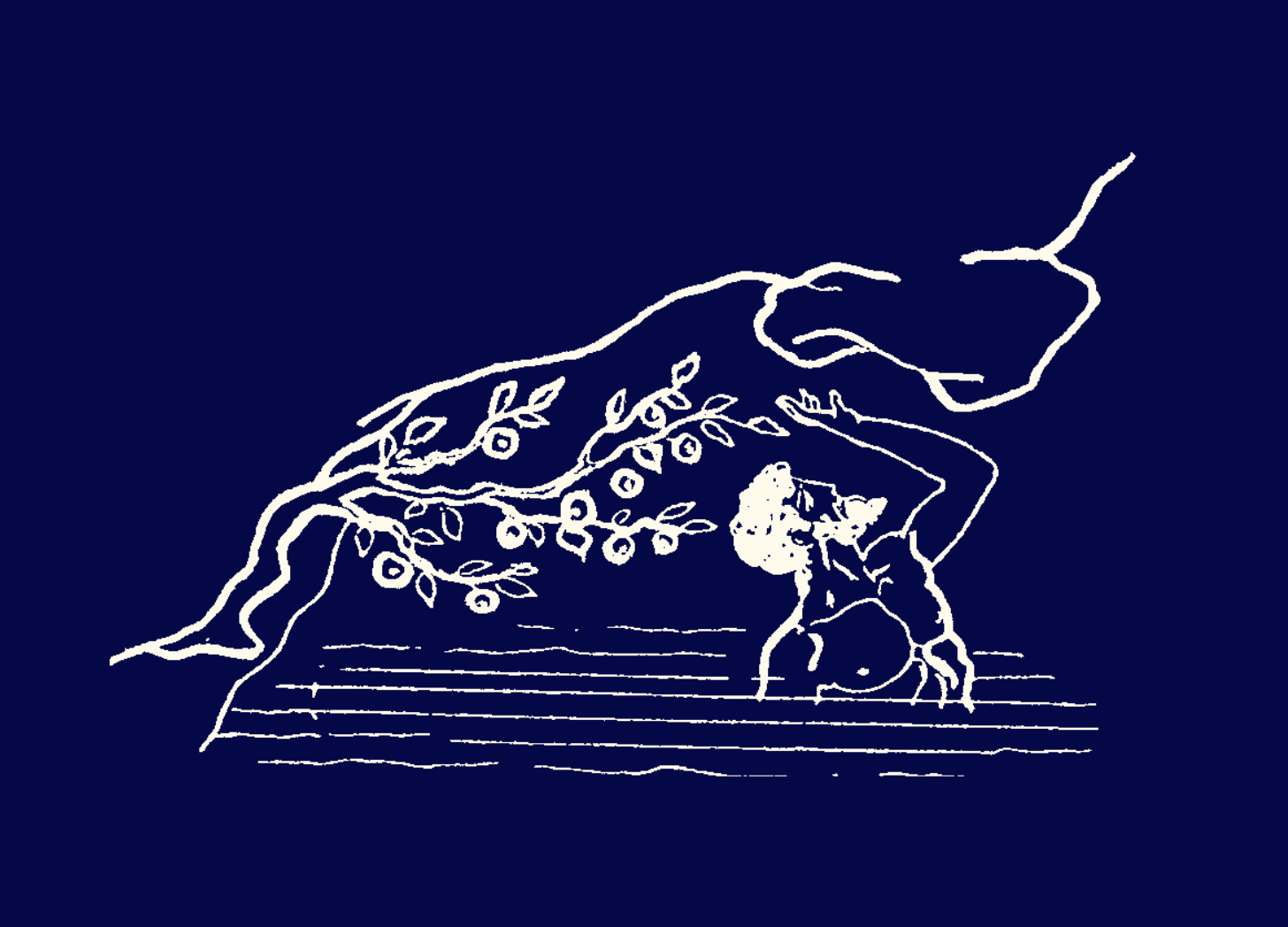
In a fragmentary epic tradition, it is said that Tantalus was allowed to spend time with the gods. And Zeus promised him that anything he wanted would come true. Tantalus asked to live a god-like life. Careful what you wish for! Zeus granted him that, but he suspended a rock above his head, à la sword of Damocles, to prevent him from actually enjoying food and refreshments. Surprisingly, this punishment appears far more often in our sources than the famous Homeric receding branches and water.
So far we have seen two types of punishment, which appear combined in Apollodorus’ account above. A conflation that Pausanias (10.31.12) thought was first attested in the painter Polygnotus (middle of the 5th century BCE). But what about the misdeeds that led to such a torture? By the time Pindar was active (6th century BCE), there must have already been a story involving a cannibalistic feast, where Tantalus served his own son Pelops to the gods. In the first Olympian, the Archaic poet denies that this was the offence. So we know by Pindar’s rejection that his audience would have in mind the version of the banquet, as the most well-known one. Some scholars have considered Pindar’s take on the myth as “pious,” even though he still fully alludes to the myth’s gruesome elements. But according to Pindar, Tantalus’ error lay in the redistribution among his friends of nectar and ambrosia.
Nevertheless, there is yet another story, with completely different elements. The scholia to the Odyssey (19.518 and 20.66) explain that Zeus’ shrine on Crete had a living golden dog. Pandareus, son of Merops, stole it and, instead of bringing it to Miletus, he left it with Tantalus. When Hermes went to look for it, Tantalus swore that he did not know anything about it. As a punishment, Zeus put Mount Sipylos on top of him. Similar enough to a rock? Another variant in the same scholium recalls a role reversal, where Tantalus was the one who stole the dog and Pandareus, the one who lied about it.

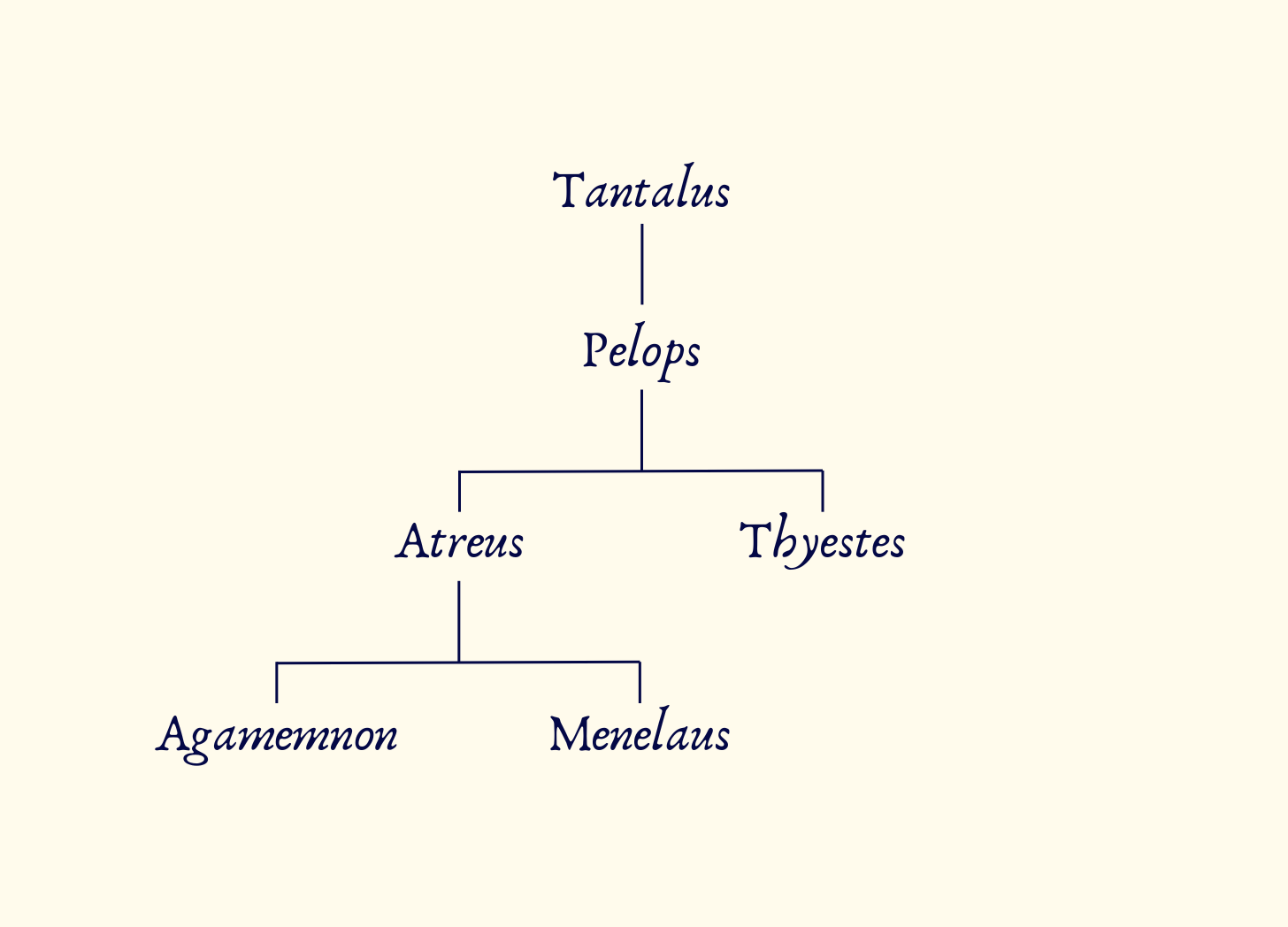
But why do we care about who Tantalus was? Well, his importance lies partly in the fact that he is one of the oldest ancestors of the Achaeans, a very old name for the Greeks. His son Pelops went on to become a powerful king (giving his name to the Peloponnessus, “isle of Pelops”) and fathered Atreus and Thyestes, whose bitter rivalry continued the family’s cycle of violence. Atreus, in particular, killed Thyestes’ sons and served them to him, who unknowingly ate his own children. Once again, the trope of the cannibalistic banquet! But most importantly, Atreus became the father of Agamemnon and Menelaus, central figures in the Trojan myth.
Now let’s get into the several etymological explanations for Tantalus’ name. A lot has been put forward and refuted on a linguistic basis. Some have tried to draw a line with talas, “wretched” and the prefix tala-, “enduring.” This is the etymology preferred by Plato in his Cratylus (395e):
The balancing (ταλαντεία) of the stone above his head, in wonderful agreement with his name; and it seems exactly as if someone who wished to call him most wretched (ταλάντατον) disguised the name and said Tantalus instead; in some such way as that chance seems to have affected his name in the legend.2
There are three ancient Greek verbs that might have also something to do with Tantalus’ myth:
tantalizō (τανταλίζω): “wave about.”
tantaloomai (τανταλόομαι): “to be balanced or swung,” like the rock on top of his head.
tantharyzō (τανθαρύζω): “quiver, shake.”
However, some linguists think that Tantalus cannot come from a Proto-Indo-European root — or at least that it is very improbable. That is, the hypothetical common ancestor of a big family of languages spoken across Europe and much of Asia, including Greek, Latin, Sanskrit, and even English. Proto-Indo-European has been reconstructed through systematic comparisons of those related languages.
Instead, bearing in mind that the myth of Tantalus is located on the frontier between Phrygia and Lydia, it is not unlikely that the root has some Pre-Greek foundation at play. Not in Hittite, however, which is also a PIE language, but rather in Hattic. In the end, Tantalus’ etymology remains as tantalising (pun intended) as the myth itself: always seemingly out of reach.

Translation adapted from Smith, R.S. & Trzaskoma, S.M. (2007). Apollodorus’ Library and Hyginus’ Fabulae: Two Handbooks of Greek Mythology. Indianapolis, IN: Hackett. I changed the ancient Greek proper nouns for their Latinised version.
Translation from Fowler, H. N. (1963). Plato. Cratylus, Parmenides, Greater Hippias, Lesser Hippias. Cambridge, MA: Harvard University Press (Loeb).